
Commercial Gutter Maintenance in Des Moines: A Property Manager's Guide
Published July 22, 2026 · 7 min read
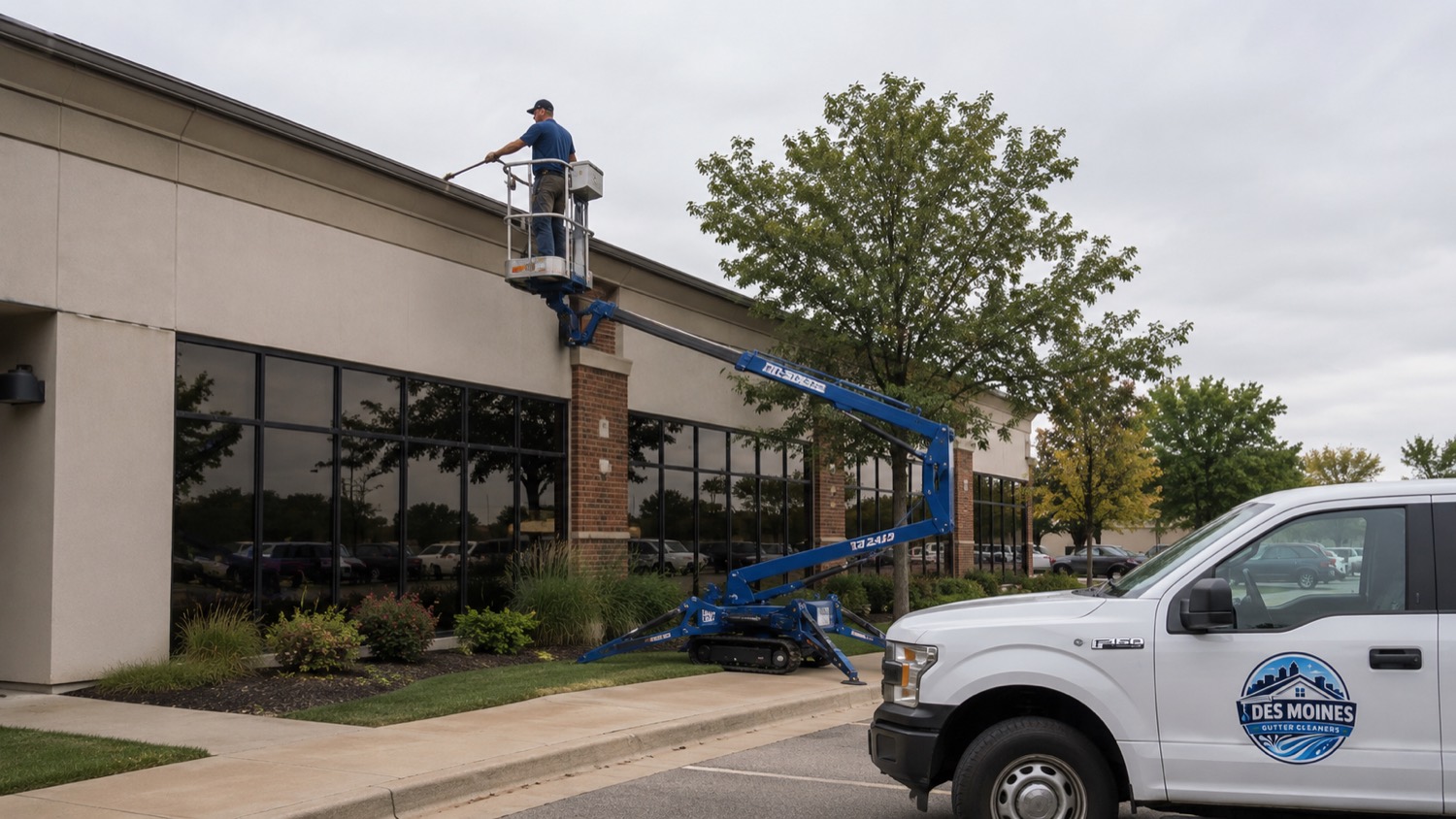
Most commercial properties in the Des Moines metro need gutter cleaning twice a year, in late spring and late fall. The scope should specify all runs cleared, every downspout confirmed draining, debris removed from the property, and a written note of any hardware problems found. What separates a commercial job from a residential one is not the gutter work. It is access, scheduling around tenants and business hours, insurance verification, and having the scope in writing before anyone arrives.
Commercial gutters have a specific failure pattern, and it is not really about gutters. It is that nobody who works in the building is responsible for looking up. The system runs fine, invisibly, for years, and then announces itself as a soaked tenant entrance or a stain down the front of the building.
Gutter work is the only thing we do, commercial included, so this is written for the person who has to evaluate a vendor and defend a line item rather than for a homeowner deciding on a Saturday project.
Why Commercial Rooflines Fail Differently
The difference that matters most is how much rides on each downspout. A long commercial roofline often drains through a small number of outlets, so any one of them can carry a meaningful share of the whole building's drainage. Lose one to a blockage and you have not lost a corner of the system, you have lost a section of it. How true that is for your building depends on how it was drained, which is worth knowing before you need to know it. Count your downspouts and divide the roofline by them; if that number is small, each one is load-bearing.
Then add the central Iowa rainfall pattern. NOAA climate normals put the Des Moines airport at roughly 36.5 inches a year, with May and June each averaging about 5.25 inches. The heaviest demand on the system arrives in a narrow window, and it arrives right after the spring debris drop has loaded the troughs.
And the ceiling on that is higher than most people plan for. In 2018, NWS Des Moines recorded five to ten inches of rain across the northern half of Polk County over about a day and a half. No drainage system absorbs that comfortably, but the difference between a clear one and a blocked one is where the water ends up going.
What Belongs in the Scope of Work
A verbal scope is the thing that turns into a disagreement in November. Get these in writing.
- Every run cleared, and every downspout confirmed draining. Not "gutters cleaned." Downspouts are the most common exclusion in this trade and on a commercial property they carry the most consequence.
- Debris removed from the property. Specify this. On a commercial job the volume is large enough that "bagged and left on site" becomes your disposal problem and sometimes your dumpster contract's problem.
- A written report of anything found. Loose hangers, separated seams, standing water in a run that is pitched wrong. This is the part with real value to a property manager, because it is early warning on a capital expense.
- Access and hours. Who provides roof or lift access, what hours work can occur, and how tenants are notified if the work affects entrances or parking.
- What happens if damage is found. Specifically, whether the vendor also sells the repair. That answer tells you how to read every problem they report.
What to Verify Before a Vendor Is on the Property
Iowa has no license for gutter cleaning. For a trade that puts people on ladders above entrances your tenants walk through, there is no state credential to look up and no board to complain to. On a residential job that is an inconvenience. On a commercial property, where you are putting a crew and equipment on premises you are responsible for, it means the verification is entirely yours to do.
Ask for proof of insurance and confirm it directly with the carrier or certificate rather than accepting a yes on the phone. Ask whether the crew is employed or subcontracted, because it changes who is actually on your site. We are not the right people to tell you what your policy requires or what your obligations are, and any contractor who confidently tells you that is overstepping. Ask your own insurer and your own counsel. What we can tell you is which questions separate a real operation from someone with a ladder, and our guide to vetting a gutter cleaning company in a state that does not license them walks through them.
Scheduled Maintenance Versus Reactive Calls
The strongest argument for putting this on a recurring schedule is administrative rather than technical. A reactive model requires someone to notice a problem, escalate it, collect quotes, and get a one-off spend approved, every single time. That process reliably takes longer than the weather does.
A schedule converts an unpredictable reactive cost into a known line item and, more usefully, gets the work done in the correct season instead of whenever the approval clears. Our season-by-season guide for the Des Moines metro covers why late spring and late fall are the two windows that matter here.
The Cases That Warrant More Than Twice a Year
Twice a year is the default, not the rule. Four situations usually justify a third visit:
- Heavy tree cover over any part of the roofline, which is common on older office and clinic properties in the established parts of the metro.
- A tenant or customer entrance directly under a gutter run. This is a service and safety issue in a freeze-thaw climate, not just a maintenance one.
- Low-slope or flat roof sections where drainage is already the roof's weak point and the gutters are the only relief.
- A property that has already had a water event. Once you know where a building's drainage fails, the frequency should reflect it.
How Commercial Pricing Works
Commercial gutter work is genuinely quote-by-property, and any vendor giving you a flat number before seeing the building is guessing. Total linear feet, the number of stories, whether the work needs a lift, and how access is arranged all move it substantially.
What you should expect regardless of the number is a scope you can compare. Two commercial quotes are only comparable when they cover the same work, which is the same principle that applies on the residential side and is covered in our guide to what is actually included in a gutter cleaning and our breakdown of what gutter cleaning costs in Des Moines.
For our part, our commercial gutter cleaning is quoted from the property details rather than a rate card, and gutters are the only service we sell, so a maintenance visit is never also a sales call for a roof.
After a Storm
Commercial properties tend to get storm follow-up wrong in one specific way: the visible damage gets attention and the drainage does not. A storm delivers a season of debris into the troughs in one afternoon, wet and packed, and on a building with few downspouts that is enough to change how the whole roofline sheds water. Our post on what to do with your gutters after a Des Moines storm covers the ground-level check, which works the same on a commercial building as on a house.
The Short Version
Twice a year, scope in writing, downspouts explicitly named, debris off the property, insurance verified yourself, and a vendor whose answer to "what if you find damage" is not "we will quote you the repair." Commercial gutter maintenance is not complicated work. It just fails quietly until it fails expensively, and everything above is about making sure someone is looking before that happens.
Commercial Gutter Maintenance
How often should a commercial property have its gutters cleaned?
Twice a year covers most commercial buildings in the Des Moines metro, timed to late spring and late fall, same as a house. The difference is what happens when you skip one. A long commercial roofline often drains through relatively few downspouts, so a single blockage can take out a meaningful share of the building's drainage rather than just one corner of it. Properties with heavy tree cover, a flat or low-slope roof section, or a tenant entrance directly under a gutter run are the common cases for a third visit.
What should a commercial gutter cleaning scope of work include?
At minimum: all gutter runs cleared, every downspout confirmed to be draining, debris removed from the property rather than bagged and left, and a written note of anything found wrong with the hardware. For a commercial property it is also worth specifying who is responsible for roof access, what hours the work can happen in, and whether the contractor needs to coordinate with tenants. The scope is where a commercial job differs most from a residential one.
What should I ask a gutter vendor before hiring them for a commercial property?
Ask for proof of insurance and confirm the coverage yourself rather than taking a yes on the phone. Ask whether the crew doing the work is employed by the company or subcontracted. Ask how they handle access and scheduling around tenants and business hours. Ask what happens if they find damage, specifically whether they also sell the repair. And ask for the scope in writing, because a verbal scope is the thing that becomes a dispute later.
Why do commercial gutters get ignored until there is a problem?
Because nobody in the building is looking up. A homeowner walks past their own downspouts every day and eventually notices the stain on the siding. On a commercial property the gutters sit outside everyone's job description until water shows up somewhere that costs money: a soaked entryway, a tenant complaint, a stained facade, or ice forming over a walkway. By then the cleaning that would have prevented it is the smallest line item in the conversation.
Is gutter maintenance worth putting on a recurring schedule?
For most commercial properties, yes, and the reason is administrative more than technical. A recurring schedule means nobody has to notice the problem, remember to act, get quotes, and approve a one-off spend every time. It converts an unpredictable reactive cost into a known line item, and it means the work happens in the right season rather than whenever someone gets around to it.
Get a Commercial Gutter Quote
Property details are enough to get you a number. Des Moines metro, scheduled or one-time.
Get a Fast Quote