
Signs Your Gutters Need Cleaning: A Des Moines Homeowner's Checklist
Published July 18, 2026 · 8 min read
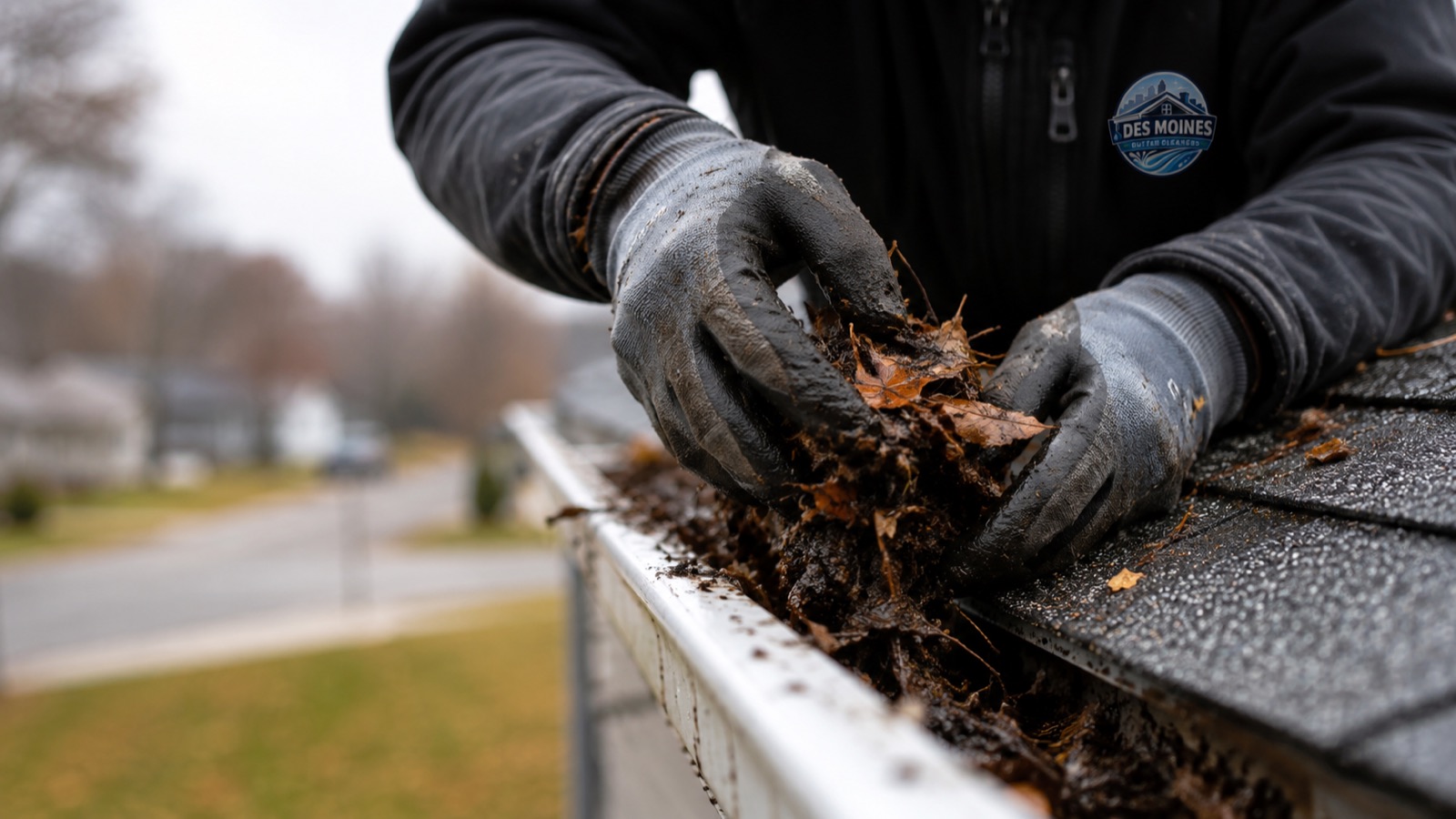
The clearest signs your gutters need cleaning are water spilling over the front edge during rain, dark streaks on the fascia, granules or debris visible from the ground, plants growing in the trough, a sagging or pulled-away section, pests around the roofline, and staining or splashback where water lands near the foundation. In the Des Moines metro, most homes should be cleaned twice a year, and a heavily wooded lot often needs a third fall visit. If you can see any of the signs below from the yard, the system is already not draining the way it should.
Gutters fail quietly. They do not announce a clog the way a furnace announces a bad ignitor. They just slowly stop moving water, and by the time the problem is obvious from the driveway, it has usually been building for a season or two.
We clean gutters in the Des Moines metro and we do nothing else, which means we spend the whole year looking at the exact symptoms below on homes across Polk, Dallas, and Warren Counties. Here is the checklist we actually use, what each sign is telling you, and which ones mean call someone this week rather than next season.
The Seven Signs Your Gutters Need Cleaning
1. Water spilling over the front edge during rain
This is the one that matters most, because it is the whole job failing in real time. A gutter that is doing its job carries water to the downspout and away from the house. A gutter that sheets water over its front lip in a steady rain is telling you the channel or the downspout is blocked and the water has found the only exit it has left, which is straight down your siding and onto the ground beside your foundation.
Go outside during the next real rain and look at the front edge. If it is running over anywhere, that section is clogged, full stop. This is also the easiest sign to catch, because it requires no ladder and no guesswork.
2. Dark streaks on the fascia and staining on the siding
When debris holds standing water in the trough, that water works its way over the back and front edges and leaves a mark. You will see it as dark vertical streaks on the fascia board just below the gutter, or as brown and black staining on the siding underneath. Those stains are a record of water that sat where it should have been draining. Even when it is not actively raining, the staining is proof the system has been holding water instead of moving it.
3. Granules, grit, or visible debris from the ground
You do not always need to be up top to see the load. From the yard, look for shingle grit collecting at the downspout outlets and for the tips of leaves, twigs, or seed litter poking above the front lip. Fall work in this metro is mostly leaves and seed litter off the older tree-lined streets, and that material packs down into a dense mat that holds water long after the last storm.
4. Plants growing out of the gutter
This is the sign nobody misreads. When you see green growth, seedlings, grass, even small weeds, coming out of the top of the gutter, the trough has enough decomposed debris in it to act as soil, and enough standing moisture to keep a plant alive. A gutter garden does not form in one clog. It means the system has been full long enough to grow something, which is usually more than a year of skipped cleanings.
5. A sagging gutter or a section pulling away from the house
A clean, empty gutter is light. A gutter packed with wet debris is heavy, and that weight pulls on the fasteners holding the run to the fascia. If you see a section drooping in the middle, or a gap opening up between the gutter and the house, the load is winning. Left alone, that section eventually tears off, and now a cleaning has become a re-hang or a replacement, which is a far bigger bill than clearing it would have been.
6. Pests, nests, or standing water around the roofline
Clogged gutters hold stagnant water and soft, rotting debris, which is exactly the habitat that draws mosquitoes, and the nesting material that birds and small animals find convenient. If you are noticing more activity around the roofline than usual, or you spot a nest tucked into a run, the gutter has stopped being a drainage channel and started being a habitat, and the fix is clearing it out rather than chasing the pests.
7. Splashback, eroded mulch, or staining where water lands near the foundation
Walk the base of the house after a rain. When a gutter overflows, all of that water comes off the roof in a sheet and lands in one spot at the ground, and it leaves evidence: dug-out mulch, splash marks on the lower siding or brick, eroded soil, or a puddle that sits against the foundation. In the metro, where a lot of homes sit on dense, slow-draining clay-heavy soil, that pooling water is the first link in the chain that ends in a wet basement. We wrote a whole piece on the connection between overflowing gutters and foundation water because it is the most expensive thing a skipped cleaning causes.
Which Signs Mean Call This Week
Not every sign is equally urgent. Streaking on the fascia and a little grit at the downspout are telling you the next scheduled cleaning is due. Water actively pouring over the edge, a section pulling off the house, or pooling against the foundation are telling you it is already causing damage, and those move to the front of the line.
The reason timing matters more here than in a milder climate is the calendar. A gutter that is clogged going into an Iowa winter does not just wait politely until spring. Once the first hard freeze arrives, a trough full of wet debris cannot drain, and standing water at the roof edge that freezes and thaws through the winter feeds ice buildup at the eave. That is one of the mechanisms that lets an ice dam form, and it turns a clog you could have cleared cheaply in November into a much bigger headache in January. Our season-by-season cleaning guide puts the two non-negotiable windows in late spring and late fall for exactly this reason.
Why the Signs Read Differently Across the Metro
The same seven signs show up faster on some streets than others. A home under a heavy canopy on a mature street loads its gutters far faster than a newer subdivision with young landscaping, which is why a house in a wooded corridor around Johnston or on the established, tree-shaded blocks of Clive can hit the "plants growing" stage in a single skipped year while an open lot goes two.
Reading how fast a given roofline loads up is something you pick up by looking at a lot of them. Most companies that will quote you here run gutter cleaning as one line on a longer menu of window washing, pressure washing, or gutter installation, so it is a task they fit between other jobs. For us it is the entire job, which is the whole reason we can usually tell a two-visit house from a three-visit one before we are even on the ladder. If you want to hand it to a crew that does this every day, our gutter cleaning service covers the whole metro.
What It Costs to Stay Ahead of It
Catching these signs early is almost always cheaper than reacting to them. A routine cleaning costs a fraction of what a soaked foundation or a rotted fascia board does, and the full breakdown of what drives the number is in our guide to gutter cleaning costs in Des Moines. If you are choosing who does the work, our guide on how to vet a gutter cleaning company walks through the questions that separate a real crew from a side gig, which matters more than usual in a state that does not license this work. If several of these signs showed up right after a storm rather than gradually, start with the post-storm check instead.
And if you are weighing doing it yourself, weigh it honestly. A widely cited study of US emergency-department data counted well over 100,000 ladder-related injuries treated in ERs every year, and gutter work puts you on wet footing at the exact height where a fall does real damage. That is a large part of why homeowners hire this out.
Signs Your Gutters Need Cleaning
How do I know if my gutters are clogged without getting on a ladder?
Watch them during the next steady rain. Water sheeting over the front lip instead of running to the downspout is the clearest ground-level sign of a clog. Also look for dark streaks on the fascia, mud splatter and dug-out mulch below the gutter line, and any plant growth or drooping section visible from the yard. Any one of those means the system is not draining the way it should.
How often do gutters actually need cleaning in the Des Moines metro?
Twice a year is the baseline for most metro homes, once in late spring and once in late fall. A heavily wooded lot often needs a third fall visit because the leaf load comes down in waves. If you cleaned in November and the gutters were already packed, that is your sign you are a three-visit house.
Can I just wait until I see a problem?
You can, but by the time a clog shows itself as an overflow stain, a wet basement, or a sagging run, the cheap fix has usually already turned into a more expensive one. Gutters are a maintenance item, not a repair item. The whole point of watching for the signs below is to catch it while it is still a cleaning.
Is it worth paying someone or should I clean them myself?
That is a personal call, but the risk is real. Research cited by the CDC found that more than 100,000 ladder-fall injuries are treated in US emergency rooms every year, and a two-story Des Moines home on wet fall footing is exactly the setup those numbers describe. Weigh that against the cost of a professional cleaning, which many homeowners decide is worth not being on the ladder.
Seeing One of These Signs?
Send us a photo and tell us where you are in the metro. Because gutters are the only thing we work on, we can usually look at a picture and a short description and tell you whether it is a routine clearing or something worth getting to this week.